


Your portfolio has been doing well.
Eventually it will do poorly.
You know this, but it’s easy to forget when you see your portfolio balance going higher and higher.
I hate to rain on your parade, but it’s an important part of my job.
Keeping you invested and your plan (and life) on track.
The current run, in numbers
The stock market has been going up since October 12, 2022.
Stocks had dropped about 25% from their highest point, about nine months earlier.
Since that low, stocks are up about 83%.
That’s a strong run.
Since 1950, the average bull market has lasted about five and a half years.
Nobody can predict what happens next, including how long this run lasts.
Even this run had a scare.
In spring 2025, a fast, sharp drop hit stocks.
But it never fell 20% from its high. So it didn’t count as a new bear market.
Most market trackers still call this one continuous run, from October 2022 to today.
Every run before this one has come to an end.
This one will too.
What pullbacks actually look like
You don’t have to look back far to find one.
In 2022, stocks fell about 25% from their high.
In early 2020, stocks fell by about a third in weeks. That was one of the fastest drops in history. Stocks climbed back to new highs a few months later.
Both times, it felt scary.
Both times, gritting your teeth and staying invested was the smart choice.
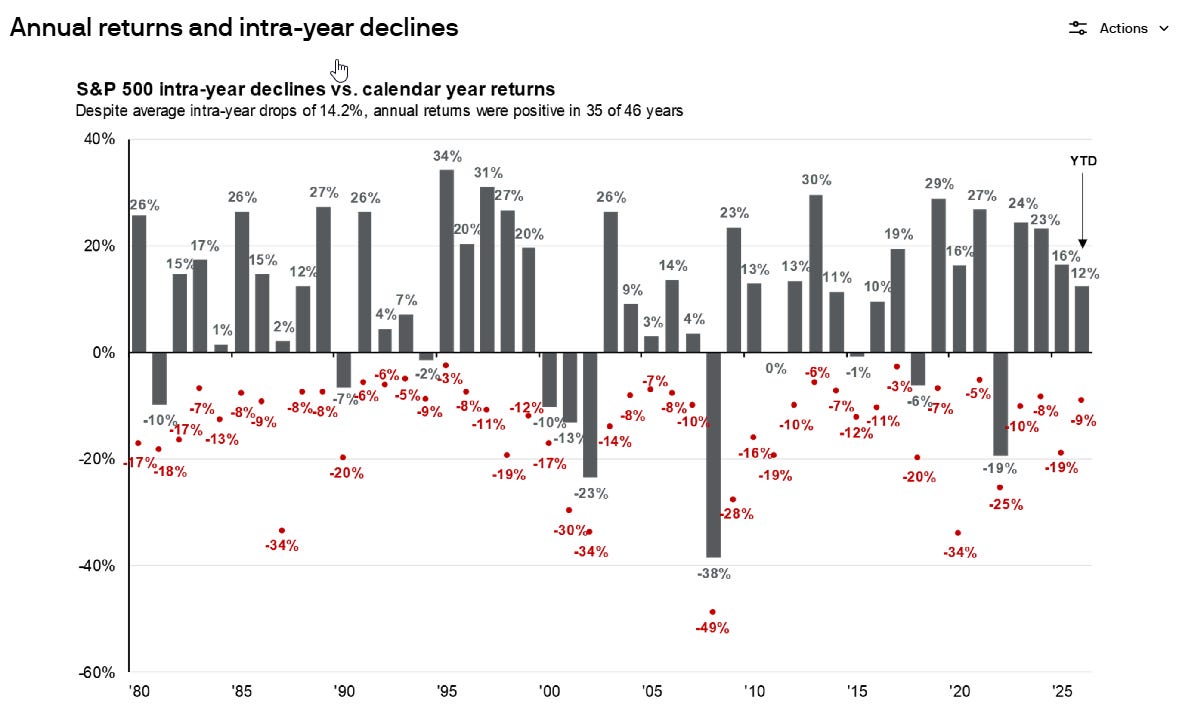
Not every drop is the same size, nor do they happen with the same frequency:
A drop of 5% to 10% is a pullback. These happen almost every year.
A drop of 10% to 20% is a correction. These happen roughly every year or two.
A drop of 20% or more is a bear market. These happen roughly once every five to six years.
When a bear market does hit, the average drop is close to 30%, top to bottom.
Market drops are the short-term price you pay for higher returns over time.
The chart below provides some visual context.
Your portfolio’s job
When your portfolio does well, you want more. To chase what’s working.
You might think, “This time is different.”
When the market drops, you want to stop the pain.
You want to get the hell out. You want to wait until things feel calm.
You tell yourself the same thing: “This time is different.”
These both miss the real point of your portfolio.
Its job is to fuel and fund your plan. Your life.
That means trips. Help for your grandkids. Living how and where you want. More choice and autonomy. Freedom and independence. Not being a burden on your family.
What the market does today isn’t important.
Your life and the plan that supports it is what matters.
The best portfolio for you isn’t the one with the highest return.
It’s the one you can stick with.
In good markets and bad.
In great markets, and markets that redefine fear in your heart.
A few questions
If your portfolio dropped 20% tomorrow, would your spending need to change?
Are you taking on more risk because it fits your plan? Or because the market has done well lately?
Think back to 2022 or 2020. What did you actually do? Would you make the same choice again?
If the next drop started next week, how hard would it be for you to hold on?
Bottom line: markets go up more than they go down. That’s why we invest.
But never forget that they can go down quickly. Violently. When you least expect it.
Acknowledging and planning for that makes sense.
If this brings up a question about your plan, hit reply. I’m always glad to talk it through.
Until next Wednesday,
Russ
P.S. — People ask me all the time: “What do you think the market will do?” My answer never changes. I don’t know. Nobody else does either, no matter how confident they sound.
Very good reminder, and explanation. Hubby and I have recently begun working with a financial planner that we feel very comfortable with. But on a personal note, we are a little microcosm (example) of what you illustrate in this post. We personally own stock in three individual companies (finance, insurance, industrial). We have, for the most part, owned them for over 45 years. On any given day they perform wildly different. One up, the other two down, two up one down. Overall they are significantly up versus when we initially bought them.