


In the last couple of weeks, I’ve written about:
Today, we continue this series of exploring key retirement planning trade-offs by focusing on WHEN you retire.
Once again, let’s use our fictional couple Mike & Sarah and start with their current, pre-retirement income:
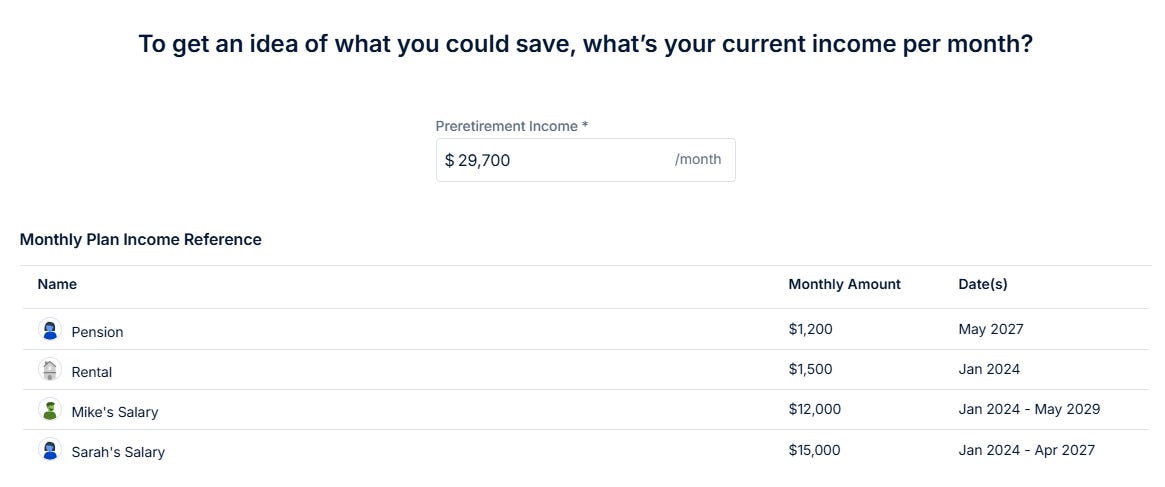
As you can see above, Mike & Sarah have combined monthly pre-retirement income of $29,700.
This includes a pension that hasn’t started yet. But depending on when they retire, it could become pre-retirement income.
Before we can dig into WHEN they can comfortably afford to retire, we need to consider what they want their retirement to look like.
How much do they want to spend once their salaries go away?
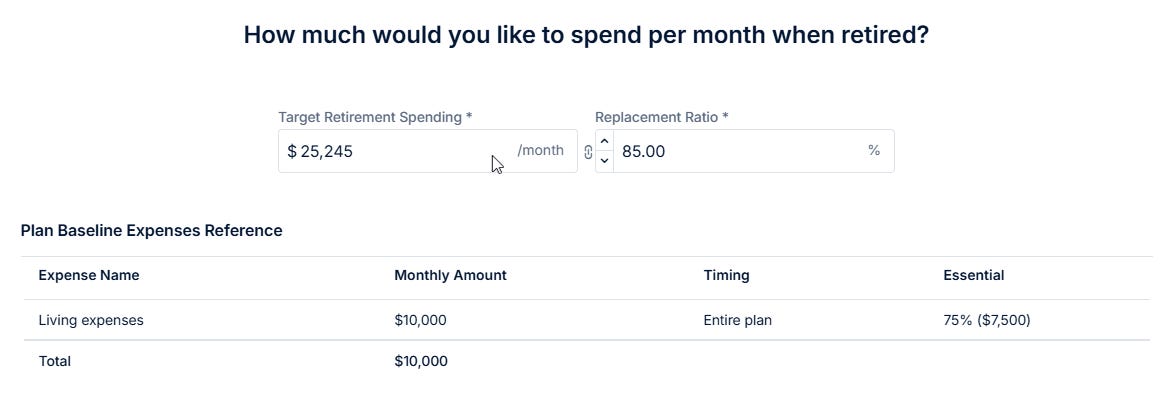
Again, this is just a sample plan and your numbers will likely be different, but Sarah & Mike want to target a retirement spending level that’s 85% of their pre-retirement income, or $25,245 per month.
Additionally, within their target monthly spending above we can further itemize their spending by identifying what they consider their “baseline living expenses” ($10,000/month) and how much of this amount they would consider as “essential” (75% or $7,500/month).
Now it’s time to factor in their savings:
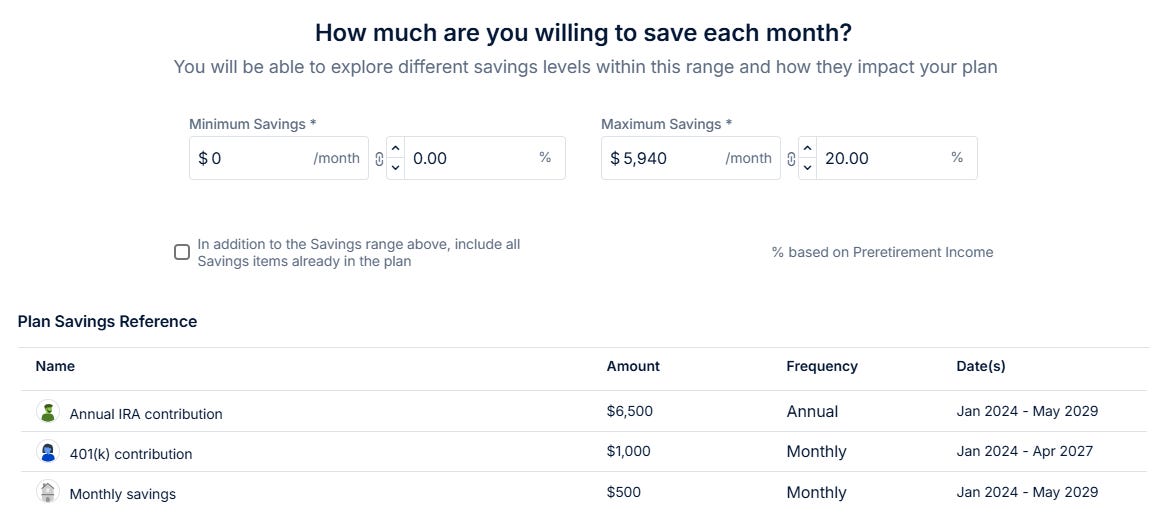
As you can see above, Mike & Sarah want to consider saving between $0 and $5,940 per month.
They’re currently saving a little over $2,000 per month between an annual IRA contribution, monthly 401k contribution, and general monthly savings.
So this analysis will also look at the trade-off of reducing or increasing their current savings level.
Finally, we get to the WHEN of retirement:
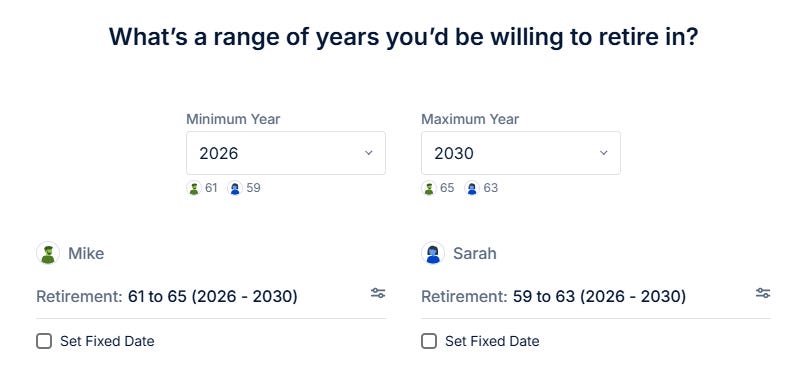
Above you can see the range of ages Mike and Sarah are each willing to consider for retirement.
All the above inputs give us the following decision chart that illustrates the trade-off between WHEN they retire, how much they save, and the amount of their retirement paycheck.
On the horizontal axis is WHEN they retire. The vertical axis shows different monthly savings amounts.
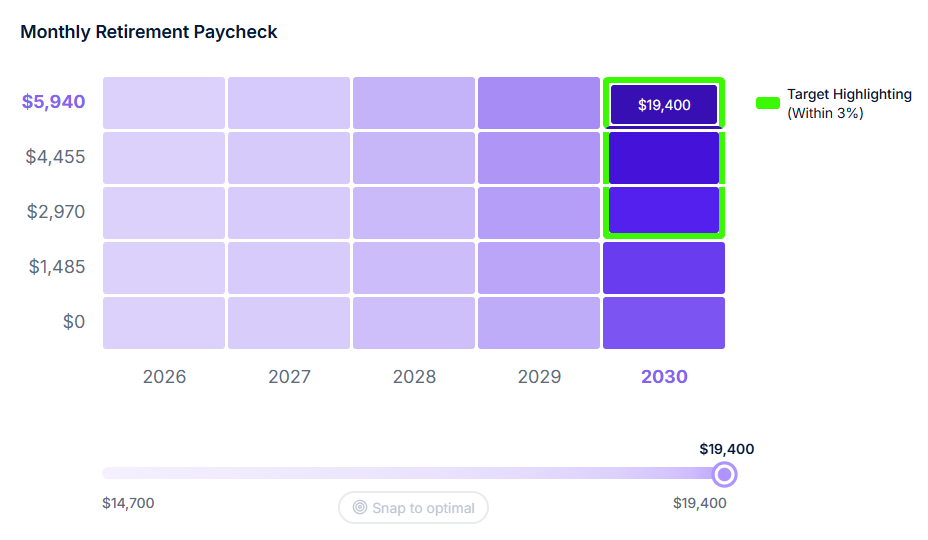
Based on the above image, if they both work until the year 2030, when Mike will be 65 and Sarah will be 63, their monthly retirement paycheck could be $19,400.
This also assumes they save $5,940 per month between now and the time they retire. This is almost 3X what they’re currently saving.
While dependent on WHEN they retire and how much they save, their retirement paycheck also factors in their portfolio, Social Security, and other details which we won’t get into today.
It’s no surprise that if they work longer and save more, they’ll have a larger retirement paycheck.
In the actual analysis, I can hover over each of those purple boxes to see their retirement paycheck at different retirement ages.
For instance, if they’re willing to accept a MUCH lower retirement paycheck, they can consider retiring today with no additional savings:
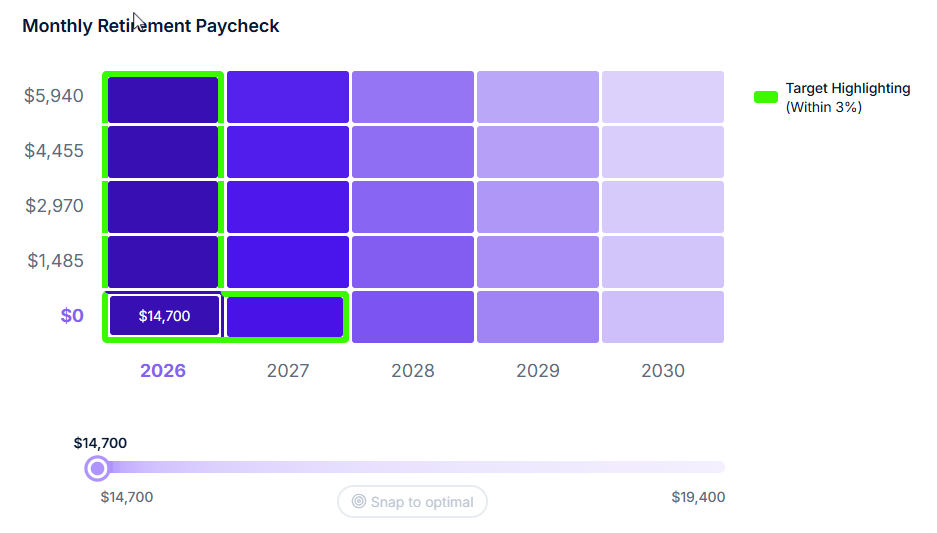
Retiring right now and not saving another dime could give them $14,700 a month, about $4,700 per month less than waiting until 2030.
Whether Sarah and Mike retire today or in 2030, their retirement paycheck is lower than their target retirement spending. That’s another trade-off for them to consider.
Some other questions relevant to their retirement date decision:
Does retiring now cover our essentials? Their essential spending goal is $7,500 a month. Retiring now pays $14,700, almost twice as much. Extra years of work only pay for their nice-to-have, non-essential expenses. Thinking of your retirement spending as essential vs non-essential can add a helpful perspective to your retirement date decision.
Do they need to retire at the same time? Mike and Sarah have different, but overlapping, retirement age ranges. One could stop now while the other works a year or two longer.
Is part-time an option? Part-time work or a phased retirement might close part of the gap without an additional year of full-time work.
Could you spend a little less instead of working longer? Their 85% pre-retirement spending target isn’t set in stone. Lowering it might move the retirement date up by years.
What would you regret more? Having less money in your 80s, or giving up a healthy year in your early 60s?
How will you fill 8+ hours every weekday? Before you retire, consider how you’ll spend your time, not just how you’ll spend your money.
Working one more year almost always improves the numbers.
It means one more year of earnings and savings. And one less year of needing to rely on your portfolio for income.
But each additional year of work is one less active, healthy year of retirement.
This reminds me of my favorite quote from one of my favorite people, Thomas Sowell:
“There are no solutions. There are only trade-offs.”
Have you ever thought or said, “Maybe just one more year”?
If so, have you considered the potential trade-offs above?
Hit reply or leave a comment and let me know.
Until next Wednesday, have a wonderful Thanksgiving,
Russ
P.S. - The numbers and math are the easy part of retirement planning. It’s what’s behind and between the numbers where things are less clear. And it’s where these trade-offs need to be evaluated in the context of what’s important to you and the life you want to live.
Hypothetical Illustration: The examples and projections presented are hypothetical and for illustrative and educational purposes only. Mike and Sarah are fictional individuals and do not represent actual clients or results. Retirement income estimates are based on assumptions regarding retirement ages, savings, spending, Social Security benefits, investment returns, inflation, life expectancy, and other financial factors. Changes in these assumptions, market conditions, taxes, healthcare expenses, or unexpected costs may materially affect actual results. Projected retirement income is not guaranteed and should not be interpreted as a promise of future income or investment performance. Investing involves risk, including possible loss of principal. Individual circumstances and retirement outcomes will vary.