


You can afford the trip.
The math says so.
You book it anyway with a knot in your stomach.
That’s not a math problem.
It’s a psychological and/or emotional problem.
Most retirement plans can tell you whether your money will last.
Almost none tell you what adjustments you’ll have to make along the way. And what would trigger those adjustments.
That gap is where the knot in your stomach lives.
Most retirement projections are either a straight-line fantasy — a steady 6% or 7% return, simple and absolutely wrong — or a Monte Carlo score that hands you a number like “87% probability of success” and stops there.
Both skip the part that actually matters: what do you do if things start moving the wrong direction? At what point? By how much?
That’s where guardrails come in.
Think of it this way: a weather forecast tells you the probability of rain. A GPS tells you when to turn, which direction, and whether you’re going to arrive later (or earlier) than planned.
Most retirement projections are weather forecasts.
A guardrails-based plan is a GPS.
The guardrails approach builds a dynamic spending strategy around your specific situation.
First, it tells you a specific dollar amount you can afford to spend each month and from which sources (Social Security, investment accounts, etc.).
This is your retirement paycheck.
It also establishes, in advance, the conditions under which you’d increase your retirement paycheck, or reduce it, and by exactly how much.
I’ve written before about a hypothetical client I call Jane Sample — a 64-year-old single woman with a $1.8 million portfolio, a mortgage-free home, and a monthly spending need of around $6,900.
When we ran Jane’s numbers through a guardrails analysis, here’s what we found.
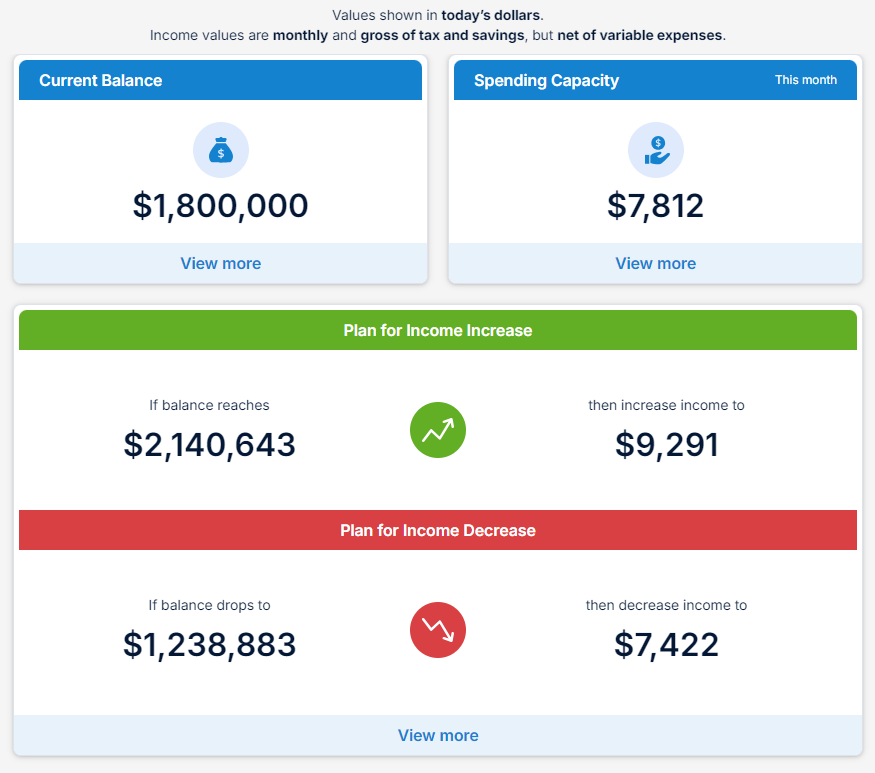
Her sustainable monthly spending — factoring in her portfolio, her Social Security benefit starting at 67, taxes, and realistic return assumptions — came to approximately $7,812 per month. That’s roughly $900 more than she thought she needed.
The retirement paycheck amount is useful.
The guardrails around it are even more useful.
Her lower guardrail: if her portfolio (not the market) dropped by 31%, to about $1.24 million, she’d need to reduce her monthly spending by about $390 — roughly 5%. A specific, known adjustment, not a lifestyle overhaul that has her living off cat food.
Her upper guardrail: if her portfolio grew by 19%, past $2.14 million, she’d be eligible for a $1,480 monthly increase.
That’s the information that was missing when you booked that trip with a knot in your stomach.
Not just odds… an exact answer for what would need to happen before anything changes, and what you’d need to do about it.
When you know your spending is mathematically sustainable, and you know precisely what would need to happen before an adjustment is required, you can spend with more comfort and confidence.
You can actually use the money you spent your career saving and investing.
With less anxiety and worry.
A few questions worth considering, whether you’re approaching or already retired:
What would trigger a change to my spending — up or down?
If an adjustment were needed, do I know, in dollars, roughly how much?
Is my current spending level based on what’s mathematically sustainable, or just what feels comfortable?
For many people, those are two different numbers. The sustainable one is often higher.
How would my spending plan have held up in challenging market periods in the past?
You worked a long time for this chapter. Spend it living, not scared to spend.
Until next Wednesday,
Russ
P.S.~ You might be interested to check out my recent conversation about the challenging retirement transition from saving to spending with Josh Patrick on his Long Strange Trip podcast.