


When your husband dies, you might expect less income.
You probably don’t expect a bigger tax bill.
The assumption
Here’s what women tell me:
Once it’s just me, my expenses will go down, so my taxes probably go down too, right?
Yes, your expenses might drop.
Your income may or may not.
The RMD from the IRA still comes out.
A pension might continue.
Social Security is deposited into your bank account each month.
The income might not change a lot.
But your filing status does.
From Married Filing Jointly to Single.
The shift
The year a spouse dies, the survivor usually files one final joint tax return.
The next year, the surviving spouse files as Single, on income that often looks like the year before.
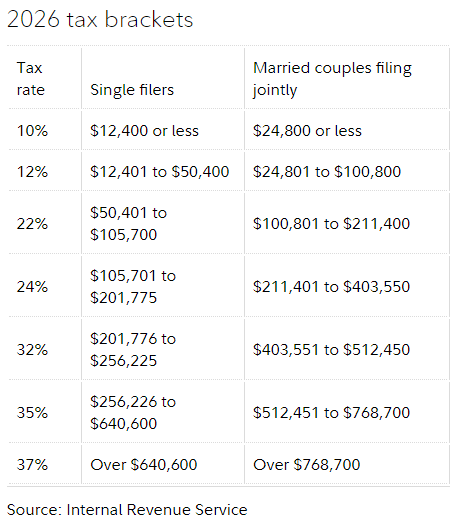
Single tax brackets are different than Married Filing Jointly brackets.
Same tax rates.
But the income thresholds are lower for Single filers, so more of the same income gets taxed at a higher rate.
The result is a higher tax bill.
The story in numbers
Picture Carol and Jim.
Together they bring in about $140,000 a year between RMDs, a pension, and Social Security.
They’ve filed jointly for decades.
Then Jim dies.
The next year, Carol’s income is $120,000.
But she’s filing Single now, and more of her income gets taxed at a higher rate than it did the year before.
Her tax bill goes up even though her income dropped by $20K.
Carol didn’t do anything wrong.
The IRS simply taxes one person earning $120,000 more than two people earning $140,000.
Based on 2026 tax brackets, here are the numbers:
Filing jointly on $140,000, their tax bill is $13,140. An effective tax rate of 9.4%.
Filing Single on $120,000, Carol's bill is $17,570. Her effective rate is 14.6%.
Less income.
A bigger tax bill.
The unpleasant surprise
If you've lost a spouse, a tax bill is the last thing on your mind.
But eventually, you’ll have to file your taxes.
By the time these numbers show up on your tax return, it’s too late to do anything about it.
The years still ahead are a different story.
What you can do
Model it now, together. You and your husband should run the numbers now to see what the survivor’s tax bill would look like. Seeing the numbers is the best way to prevent surprises.
Consider Roth conversions. Converting money from a traditional IRA to a Roth while still married filing jointly can shrink future RMDs. This can lower the tax bill for a widow.
Use Qualified Charitable Distributions. If giving is already part of your plan, QCDs reduce taxable RMD income now, which can lower future taxes for a survivor.
Look at where your money sits. Some accounts pay taxes now, some later, some never. Different account types can change how much choice a survivor has over her own tax bill each year. That’s worth reviewing sooner rather than later.
Bottom line
Nothing went wrong here.
This is simply how our tax code works. Thankfully, it can be planned for.
If this is relevant to you or someone you love, I’m happy to have a conversation.
Hit reply or reach out anytime.
Until next Wednesday,
Russ
P.S. — If you know a couple where one of them handles “the money stuff” and the other doesn’t, this is a good one to share with them. The spouse who isn’t usually into the numbers is exactly the one this one surprises.