


I recently wrote about beneficiary designations and how they override your will without asking permission.
Readers were surprised to learn that an outdated form on a single account can undo years of estate planning.
But there’s another quiet override sitting right next to those forms.
It’s how your accounts and property are titled.
When the title and the will disagree, the title wins.
Every time.
The titling options worth knowing
There are more options than people realize, and the differences matter.
Individual (sole name). You own it alone. At your death, it passes through your will — and through probate.
Joint with rights of survivorship (JTWROS). Two owners. When one dies, the survivor automatically owns the whole thing. No probate. No will involvement. This is the most common form between spouses.
Tenants in common (TIC). Two or more owners, but each owner’s share passes through their own estate when they die. The surviving co-owner does not automatically inherit. People assume “joint” always means survivor takes all. It doesn’t.
Tenants by the entirety. A spouses-only version of joint ownership available in some states. Offers extra protection from creditors. Rules vary widely by state.
Community property. Only nine states. If you ever lived in Texas, California, Arizona, or another community property state, the rules around what you own — and what gets a step-up in basis — can follow you.
Trust-titled. The account is owned by your trust. The trust controls who gets it and when, often without probate.
Transfer-on-death (TOD) or payable-on-death (POD). Technically a beneficiary designation rather than a title, but they live on the same form and operate the same way. They bypass the will.
A quick note before we go further: the goal here isn’t to avoid probate at all costs.
Probate is usually manageable, especially in Georgia. Florida, not so much.
The goal is alignment — making sure the title matches your intent.
“And” vs. “or” — what really controls your account
This one trips people up.
The traditional rule sounds simple: a joint account titled “Mary and John” requires both signatures. “Mary or John” lets either owner act alone.
That’s still the principle. But it’s not always how modern accounts work.
The determining factor is the signature card and account agreement you signed when the account was opened.
Most retail banks today default joint accounts to “either signer can act alone” — regardless of how the names appear on statements. True two-signature accounts have largely become a commercial product, not a personal one.
The older distinction still matters in some places:
Accounts opened decades ago under different rules
Some credit unions and smaller community banks
Some brokerage and investment accounts
Many trust and fiduciary accounts
Why this matters:
A true “both signatures required” account can quietly become a trap. If one spouse has a stroke, develops dementia, or otherwise can’t sign, the account effectively freezes for the other one too. Right when access is most needed.
An “either signer” account is more flexible. Bills get paid. Money moves. Life continues without a trip to the bank or to court.
That flexibility cuts both ways. The convenience depends on trust — and on the other person acting in good faith.
For most married couples, “either signer” is the right setup, paired with mutual trust and regular conversations about what’s happening in the accounts.
So don’t rely on what the statement shows. Pull out your signature card or account agreement — or call your bank — and confirm what your account actually allows.
Then ask yourself if it still matches what you’d want today.
The mistake I see most often
A widow tells me her adult son is “on the account” so he can help pay her bills.
She means well. He means well.
But adding an adult child as a joint owner — instead of using a power of attorney — quietly does a few things she didn’t sign up for:
It exposes her account to her son’s creditors and any future divorce.
It can disinherit her other children, because the account passes to him alone at her death — regardless of what her will says.
It can be treated as a gift for tax purposes.
And if Medicaid is ever needed down the road, it complicates the look-back.
The fix is almost always a durable power of attorney. Same goal — someone who can help if she can’t. Without the unintended ownership transfer.
If your goal is help managing the account, a POA is the right tool.
If your goal is to give the account away at your death, a beneficiary designation is the right tool.
Joint ownership is rarely the right answer for either one.
The trust funding gap
If you have a trust — and many of you do — the title on each account decides whether the trust actually controls it.
I’ve seen plenty of beautifully drafted trusts that own almost nothing.
The attorney drafted the document. The accounts and your house were never re-titled.
When the owner died, the trust did exactly nothing for those accounts. They went through probate.
Worth checking. The fix is usually straightforward.
A note on cost basis at the first death
For non-retirement accounts, sole-name vs. joint titling makes a real difference at the first spouse’s death — particularly in non-community-property states like Georgia.
In a sole-name account, the entire account gets a step-up in cost basis when the owner dies.
In a joint account, only half does.
That difference can be meaningful for couples with significant taxable investment accounts.
It’s worth a conversation with your advisor and tax professional before you assume joint titling is automatically the right move.
What to do next
Pull a list of every account and how it’s titled. Investment, retirement, bank, real estate. Write down the exact ownership as it appears on the most recent statement or deed.
Check joint accounts carefully. Are they JTWROS or tenants in common? Are they “and” or “or”? Ask the custodian if the paperwork doesn’t make it obvious.
Confirm trust-funded accounts are actually titled to the trust. Open the most recent statement and read the registration line.
Reconsider “convenience” joint accounts. If you’ve added an adult child to an account so they can help, ask whether a durable POA would do the job better.
Don’t forget the home. Your deed has its own titling, and the same principles apply.
Loop in your advisor and your estate attorney with specific questions. Don’t just send a list — ask them to walk through each account and confirm the title still reflects your wishes. Most clients haven’t done this in five years or more.
Like beneficiary designations, account titling isn’t a topic that comes up unless someone raises it.
But the day it matters, it matters a lot.
If you’d like a second set of eyes on your account registrations and how they line up with your wishes, just reply to this email.
I’m happy to help.
Links and things
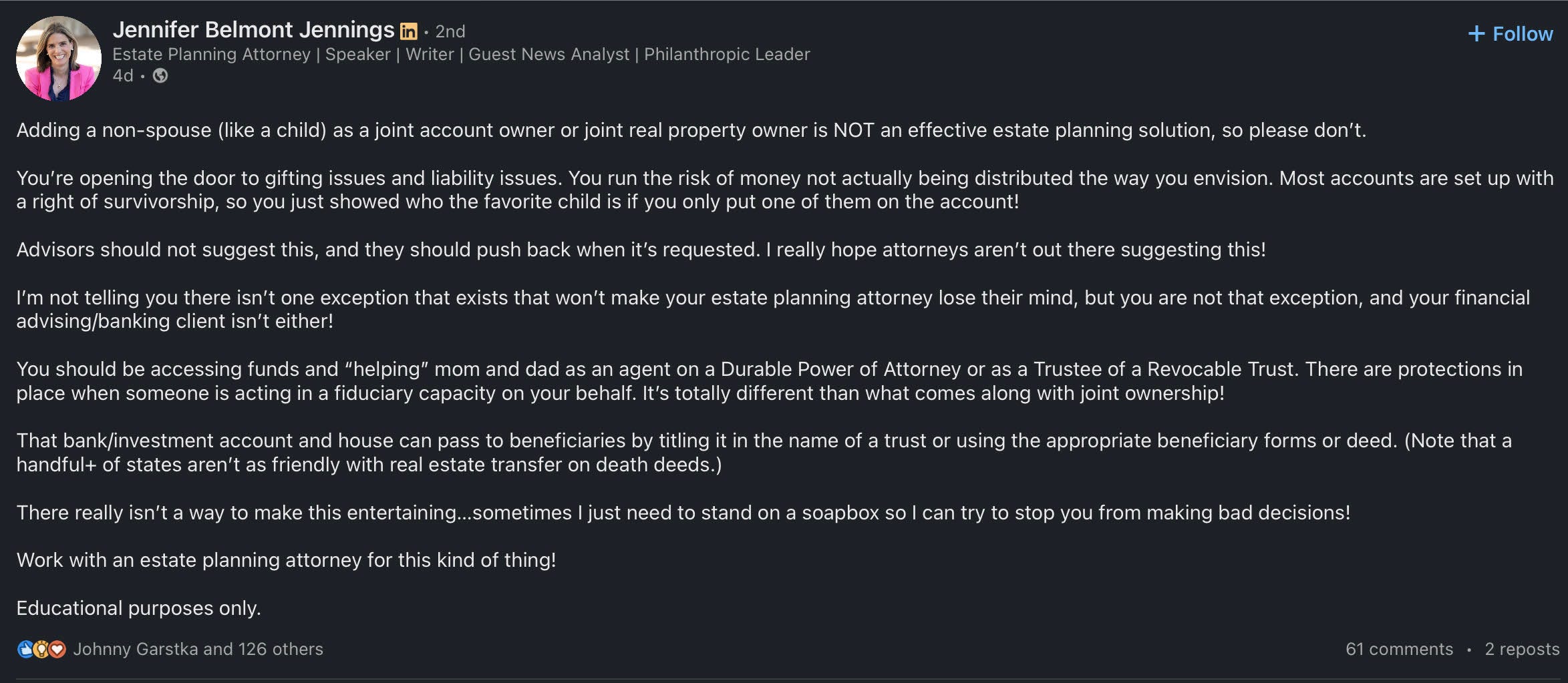
I just happened to stumble across this Linkedin post from St. Louis estate planning attorney Jennifer Belmont Jennings a couple of days ago.
She seems to agree that’s it’s rarely, if ever, a good idea for a non-spouse to be a joint account owner.
Thank you for reading!
Have a question? Reply to this email — I read every one and I’ll respond personally.
Until next Wednesday,
Russ
We had a lot of hard lessons learned in dealing with various estate administrations between my parents and my husband's mother and bachelor uncle. We have been working on making sure all of our information is up to date - wills, POAs, beneficiaries, TODs, PODs, etc. Ongoing battle as there is always something. We also have worked on some of these things for our adult children so that if something were to happen to them, we wouldn't be stuck dealing with the court system (they currently are both single, but no longer minors). Lots of good things to consider in this article. Thanks for sharing.