


Leaving your kids a traditional IRA is a gift. One that used to keep on giving.
Then the rules changed in 2020.
Some of you already know what it’s like to inherit an IRA, and are familiar with the tax bill that comes with it.
My hope is that after reading this piece, you’ll take a more thoughtful approach to how your IRA will pass to your beneficiaries. That you’ll ask whether there’s something you can do now, instead of waiting until it passes at your death.
What changed
It used to work like this.
Your grown child inherited your IRA. She had to take a little out each year. The rest kept growing for decades, and she paid tax only on what she took out.
It was commonly referred to as a “stretch” IRA.
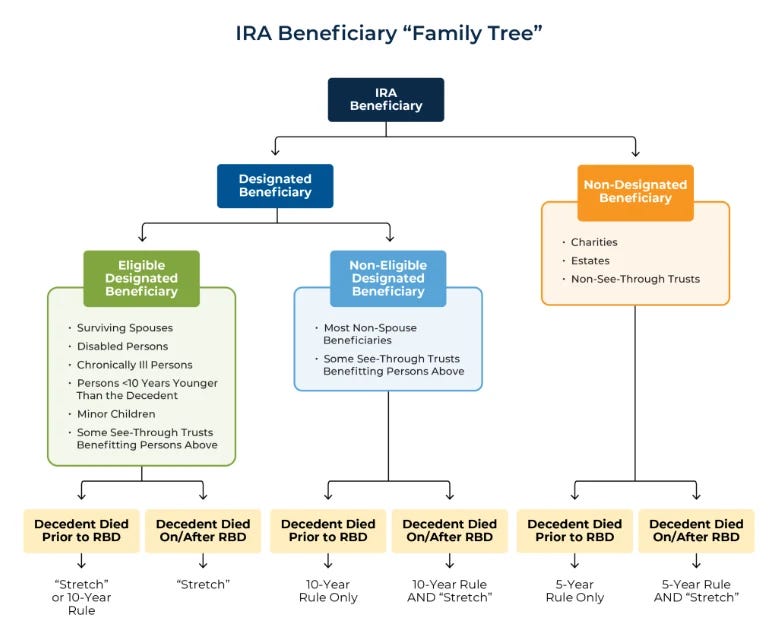
The SECURE Act ended the stretch IRA for most heirs.
Now most non-spouse beneficiaries have to empty the account within 10 years of your death. And they likely have to take some out every year along the way.
A few people still get the old rules, such as a spouse. This chart shows who’s who:
I covered more of the details in “The IRS makes up its mind” back in July 2024.
Several of my clients inherited IRAs from a parent.
Each year they take out what they’re required to, and it has to be empty by year 10.
They know how this gift feels, tax bill and all.
A gift with the bill attached
An IRA is a wonderful thing to leave to your kids. And it’s great to inherit. Far better than nothing.
But the money in a traditional IRA has never been taxed. The IRS owns a part of every dollar in this account.
Leave the IRA to your kids, and the tax bill transfers to them. And it has to be paid within 10 years.
Margaret and Sarah
Margaret and Sarah aren’t real people, but their numbers are typical of what I see.
Margaret passes away at 88. She has $1.5 million in her IRA, and she splits it evenly between her two kids.
Her daughter, Sarah, is 55.
She and her husband earn about $400,000 a year. They’ve worked hard. They save as much as they can in their 401(k)s. Their son has one more year of college. And each November, they meet with their financial advisor to do some proactive tax planning.
Then Sarah inherits $750,000 in an IRA. And the 10-year clock starts.
Vanguard looked at this problem closely. For most heirs, the lowest-tax strategy was to take the money out in even amounts over the 10 years. For Sarah, that’s about $100,000 a year.
That extra $100,000 is added to their current income. It pushes them from the 24% tax bracket into the 32% bracket.
Their federal tax goes up by about $29,000 a year. For 10 years.
And they might have state tax too.
What if Sarah just waits?
The rules only make her take approximately $25,000 in the early years. But by year 10, close to $900,000 could still be sitting there if the investments grow. It all has to come out that year. Much of it would be taxed at 37%, the top rate.
Either way, the tax planning Sarah and her husband worked so hard on could get derailed.
Why we put this off
So why don’t more people deal with this sooner?
The people I work with cherish their kids. They want to take care of them and give them a better life.
But two worries keep coming up.
“What if I need the money?”
“What if something happens to me?”
And under both is the question I hear more than any other:
“Am I going to be okay?”
That’s a fair question.
The easy answer is to leave your IRA alone, just in case.
But doing nothing is still a choice. It means your kids pay the bill.
They pay it at their tax rate, likely in their peak income years.
Your potential planning window
Margaret was retired for 20+ years.
For many of those years, her taxes were low. She lived primarily on Social Security and her savings.
Now picture her at 65.
Her Social Security is about $40,000 a year. That leaves room to add about $90,000 of income each year and still stay in the 22% bracket.
That might be an opportunity.
Each year, Margaret could move some of her IRA over to a Roth IRA. This is called a Roth conversion.
She pays tax on what she moves, at 22%. After that, the money grows tax-free, and Sarah won’t owe income tax once she inherits it.
What if Margaret had converted $100,000 a year, starting at 65?
Margaret would have paid about $22,000 in tax. Sarah, inheriting it, would pay about $29,000.
Do that for 10 years, and about $70,000 stays in the family (and doesn’t go to the IRS). That’s before any state tax, and before any tax-free growth.
The best part?
Margaret doesn’t give up control or access to the money. A Roth IRA is still her account. If she needs it, it’s there.
But the window doesn’t stay open forever.
At 75, Margaret has to start taking about $61,000 a year out of her IRA. That uses up most of her room in the lower tax bracket. The sooner she starts, the more choice she has.
Roth conversions aren’t for everyone.
They can raise your Medicare premiums. And they work best when you pay the tax from savings outside the IRA.
The only way to know is to run your own numbers.
What to do next
Check your beneficiary forms. Look at every IRA and 401(k). Are the right names there? Is anyone missing? Did you name backups? If it’s been a few years, look again.
Talk with your kids. Tell them what’s coming and how the 10-year rule works. If they know now, they’ll have time to plan. And if talking with your kids about this feels awkward, keep it simple. Try something like, “I want you to know how my IRA will work when it comes to you.” Or have a family conversation with your financial advisor.
Determine if you have a lower-tax window. A Roth conversion might help. So might leaving part of your IRA to a charity you care about, since charities don’t pay income tax. Run the numbers with your advisor to explore your options.
Bottom line
Your IRA will be a gift. The tax bill doesn’t go away.
But you can help decide who pays it and when.
If you’d like to look at your own numbers, reach out anytime.
Until next Wednesday,
Russ
P.S. A quick personal update: as of October 1, I’ve joined TVAMP as a shareholder and wealth advisor. That’s why this email came from a new address, russ.thornton@tvamp.com.
The work itself isn’t changing. I’ll keep helping women plan for and live in retirement, and I’ll keep writing here. What’s new is a team of nearly 40 advisors and staff behind me, which gives the women I work with real continuity for the long run. You can learn more at TVAMP.com.
This piece is educational and informational only. It's not tax, legal, or investment advice.