


I spent most of Thursday last week at Northside Hospital for hernia surgery.
Despite all the problems with our healthcare system, my surgeon and his team did something remarkable: they communicated clearly.
Before I even walked through the door, they emailed me documents about pre-op and post-op care.
What I could eat before.
What I could eat after.
The fact that I couldn’t lift anything heavier than 20 pounds for two weeks.
A week before surgery, a nurse called to review my medical history, medications, and prior surgeries.
It wasn’t just helpful for me—it gave my wife Elizabeth peace of mind knowing what the plan was going into it.
They even scheduled a post-op phone call two weeks out, well before the actual procedure.
The result?
I knew what to expect.
I felt prepared.
And when the day came, there were no surprises. Thankfully!
Here’s the idea: clear expectations reduce anxiety.
Vague promises create it.
And yet, in the financial advice world, the gap between what clients expect and what they actually get is enormous.
The expectation gap is costing you
Maybe you thought you were hiring a comprehensive financial planner, but you got an investment advisor who never looks at your tax return.
Maybe you expected proactive communication, but your advisor goes silent for months after the first meeting.
Maybe you thought you’d get help with estate planning and insurance, but all you got was a sales pitch for permanent life insurance. Or an annuity.
Or maybe you’re working with someone who manages 200+ clients and can’t return your calls for three days.
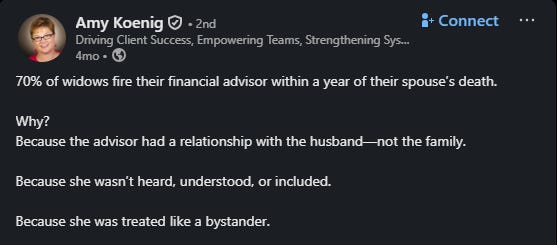
Here’s a sobering stat: 70% of widows change advisors within 12 months of losing their spouse.
Why?
See the following Linkedin post for one perspective:
The expectation gap isn’t just one thing.
It’s everything.
It’s communication style, responsiveness, topics covered, meeting frequency, and whether your advisor actually knows what you want and why.
What you deserve (and should demand)
You deserve an advisor who sets clear expectations upfront—like a good surgeon does before a procedure—and then follows through with ongoing monitoring, not a one-time transaction.
Here’s what that looks like:
Transparency. You should know exactly what your advisor does, what they don’t do, and how they’re compensated. If they can’t explain it in plain English, that’s a problem.
Clear, consistent communication. You should know how often you’ll meet, how quickly they’ll return emails or texts, and what topics they’ll help you with. If you have to chase them down, something’s wrong.
Time invested in knowing you. Your advisor should understand what you want financially and otherwise—not just your account balance. If they haven’t asked about your goals, your worries, or what keeps you up at night, they’re not doing their job.
The pre-op checklist: what to do before you hire (or re-evaluate)
Think of this like preparing for surgery.
You wouldn’t show up without understanding the plan.
Don’t hire an advisor without setting clear expectations either.
Write down your top 3 expectations. Meeting frequency, communication style, topics you need help with. Then ask the advisor directly: “Can you deliver this? How?”
Ask for their relationship standards. Request a written summary of what they commit to—and what they expect from you. If they don’t have one, have a conversation with them about your expectations as well as theirs. Click here to see my Client Relationship Standards document.
Test responsiveness early. Send an email or text in the first week or two. If it takes three or more days to hear back, you’ve learned something important.
Audit the first six months. Are you getting what was promised? If not, speak up—or consider finding a better fit.
If you’re already working with someone, schedule a relationship check-in. Bring your list of expectations. A good advisor will welcome the conversation.
Ongoing health monitoring: why this isn’t one-and-done
Here’s the thing: even with clear expectations and great communication, life happens.
Markets shift.
Your priorities change.
Your health changes.
Your family situation evolves.
The goal isn’t perfection. It’s a partner (and a plan) who adjusts with you.
My surgeon didn’t just do the procedure and disappear.
He scheduled that post-op call two weeks out because he knows recovery isn’t instant. He knows complications can arise. He knows ongoing monitoring matters.
Your financial life is the same.
A good advisor doesn’t just build your plan and vanish.
They check in regularly, adjust as needed, and stay proactive about taxes, estate updates, and risks you might not see coming.
That’s the difference between a transaction and a relationship.
Bottom line
You deserve an advisor who communicates clearly, sets realistic expectations, and then actually delivers on them.
You deserve someone who works with 60+ clients, not 200, so they can return your calls the same day.
And you deserve a partner who sees this as ongoing health monitoring, not a one-time procedure.
If you’re not getting that, it’s time to speak up—or find someone who will.
Want an advisor who sets clear expectations and actually keeps them? Let’s talk.
Inspired by Meghaan Lurtz’s recent piece on rules of engagement:

Update
A few weeks ago, in September, I introduced CareHub by CareAlly:

They’ve recently decided to change direction with their business and CareHub will no longer be available.
However, if you have any questions or needs related to caring for aging loved ones, I know many professionals that work in this area including Dottie & Doug, Lisa, Laura, Natasha, Kaye, Melanie, and others.
Please let me know if you have any questions or needs related to caring for aging family or friends and I’ll be happy to help!
I appreciate your continued readership.
Please let me know if you have any feedback or suggestions for future essays.
Have a very Happy Thanksgiving,
Russ
If you aren't getting open, honest communication in the financial industry, 1) you're not alone, it's all too common, and 2) go out and find it! There are more and more people in it to help people, not just to move money around.