


The stock market has been pretty good for a long time.
But here’s an important reminder: the market doesn’t go up in a straight line forever.
Quick story…
In early 2020, when COVID hit, many of my clients were understandably scared for many reasons…
In just a couple of weeks, their portfolios were down 15% to 20%.
The news was scary, constant, and loud.
Some wondered if they should cash out.
Wait for things to “settle down.”
Then again in 2022, as inflation and interest rates shot up, fear returned.
Those same clients were worried that decades of savings were at risk.
But they had a plan.
They knew a drop in their portfolio value didn’t mean an equivalent drop in their retirement paycheck.
Their guardrails—what I think of as a retirement income GPS—helped them stay on course.
Today, their portfolios are worth more, and their plans are still on track.
Bear markets are a normal, temporary part of investing.
They will absolutely hurt in the moment, but they’re the very reason long-term growth is possible.
What history tells us
If you have a decade or more of investment experience you’ve seen (and felt) the market drop.
But it helps to know what’s “normal.”
Frequency: Bear markets—drops of about 20% or more—show up every 3–5 years on average.
Duration: The typical bear market lasts about a year, sometimes shorter, sometimes longer.
Depth: The average decline is around 30–35%. Some are shallower. Some cut portfolios in half.
Extremes: The Great Depression (1929–32) saw an 85% drop. The 2007–09 financial crisis cut markets by 50–55%. On the other hand, the 2020 COVID crash was over in a few months.
Bottom line: temporary downturns are part of successful long-term investing.
They vary in length and depth, but they always come.
And they always go.
The bigger risk
Here’s the real danger: sitting in cash.
It feels safe.
It feels calm.
But it ain’t.
Over a long retirement, inflation is your #1 enemy.
If your cost of living doubles over 20–30 years—as history tells us it will—then cash is guaranteed to lose purchasing power.
This means your money won’t be able to keep up with your life getting more expensive over time.
That’s why investing is necessary.
The market may be bumpy, but it has always rewarded patience more than fear.
“Optimism is the only realism.” - Nick Murray
Think of guardrails as your GPS
Just like a GPS doesn’t prevent traffic jams or bad weather, your retirement income guardrails don’t prevent market drops.
But they do keep you pointed in the right direction.
If markets fall, your GPS signals a small - and temporary - reduction to your retirement paycheck.
If markets rise, you may get a retirement pay raise.
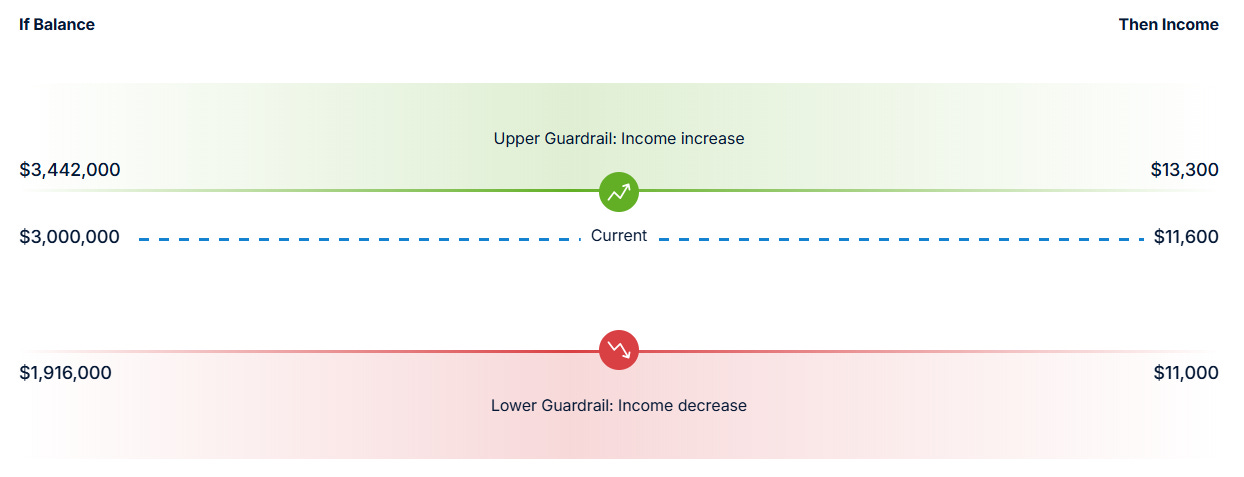
Either way, you don’t have to white-knuckle the wheel every second.
You know you’ll be guided back on track.
That’s how I want you to think about bear markets.
They’re detours, not dead ends.
What to do next
Build your plan. If you don’t have a personalized retirement income plan, that’s the first, most important step.
Invest with purpose. Use a diversified, low-cost, tax-efficient portfolio aligned with your plan.
Review your plan and portfolio. Not every day—but on a steady rhythm.
Use the tools. Tax loss harvesting, rebalancing, and smart asset location all help turn volatility into opportunity.
Check your guardrails. Review your retirement income guardrails to see where you stand and how your paycheck may need to adjust.
Get proactive tax planning. Make sure every financial decision fits into your lifetime tax picture, not just this year’s.
Bottom line
Short-term volatility is the price of admission for long-term wealth preservation and growth.
Bear markets will come and go, but with a clear plan and a retirement income GPS guiding you, they don’t have to derail your future.
Reply with any questions or get in touch if you’d like to discuss this further.
Here’s another perspective (and reminder) on Bear Markets.
It’s a short article from Ben Carlson I’d encourage you to read:
As I mentioned a couple of weeks ago, CareHub offers free educational webinars on a regular basis.
Their next one is scheduled for October 21st at 1pm Eastern.
The topic is “Beyond Google: The Smart Way to Find Local Resources for Aging Parents.”
If you’re interested in attending, click here to join CareHub for free and you sign up within their online platform.
I appreciate your continued readership.
Please let me know if you have any feedback or suggestions for future essays.
Until next Wednesday,
Russ